SF Revenue is the single money engine behind every product in your fleet. It handles prepaid wallets, usage metering, subscription lifecycle, dunning, and live MRR/ARR analytics — so you never wire Stripe yourself.
Set up your plan catalogue, connect your Stripe account, and watch the metering, dunning, and analytics run themselves. Get early access to SF Revenue.
Questions? Email us at support-sf-revenue-sf-core@saas-factory.ai
[ REVENUE COCKPIT ]
One cockpit. Every dollar.
The SF Revenue dashboard gives founders a real-time view of MRR, ARR, wallet runway, and churn risk — no finance background required. Power stays under the hood; the cockpit shows exactly what matters.
Live MRR / ARR with monthly movement breakdown
Wallet balance, runway, and auto top-up controls
Per-product billing stats and subscription counts
Churn risk scores updated every 24 hours
[ MONEY RAILS / HOW IT WORKS ]
Two rails. Every dollar tracked.
SF Revenue powers both directions of the fleet's money flow — from SaaS Factory billing product owners, and from product owners billing their own customers.
RAIL 01 — PLATFORM BILLING
SaaS Factory bills you
Your operating expenses land in a prepaid wallet. Every AI job, API call, and compute second is metered, rated, and atomically deducted — no surprise invoices at month end.
RAIL 02 — PRODUCT BILLING
You bill your customers
Connect via Stripe Connect, mint your plan catalogue, and let SF Revenue handle checkout, per-use charges, the client-money ledger, and payout requests.
STEP 03 — USAGE METERING
Usage rated, markups applied
Every event arriving through SF Core's ingest hub is validated against your registered category list, priced with your markup rules, and folded into the next invoice automatically.
STEP 04 — DUNNING & RECOVERY
Late payments chased automatically
The dunning ladder runs on its own — reminder, warning, final warning, suspension, cancellation — with churn-risk signals shaping which customers get soft treatment and which get the full sequence.
Atomic credit deduction with idempotency guarantees. Auto top-up fires before your pipeline stalls — threshold, amount, and card all configurable from the cockpit.
Usage metering
Every event validated against your registered category list, rated with markup rules, and written to the next invoice. Mis-categorised events surface immediately — not 24 hours later.
Plan catalogue
Flat subscriptions, metered add-ons, and annual billing — all mintable from the pricing editor. AI-prepared plan suggestions for you to approve, not hand-key.
Revenue analytics
Live MRR, ARR, new/expansion/contraction/churned movement, top plans, and cohort retention — updated in real time, scoped per product.
Dunning & collections
A full reminder-to-cancellation ladder that reads churn risk before sending. Customers flagged as high-value get softer treatment; the rest follow the full sequence.
Stripe Connect payments
Onboarding, KYC, checkout, per-use charges, client-money ledger, and payout requests — Stripe is only ever touched here, never in any other product.
[ COLLECTIONS / DUNNING ]
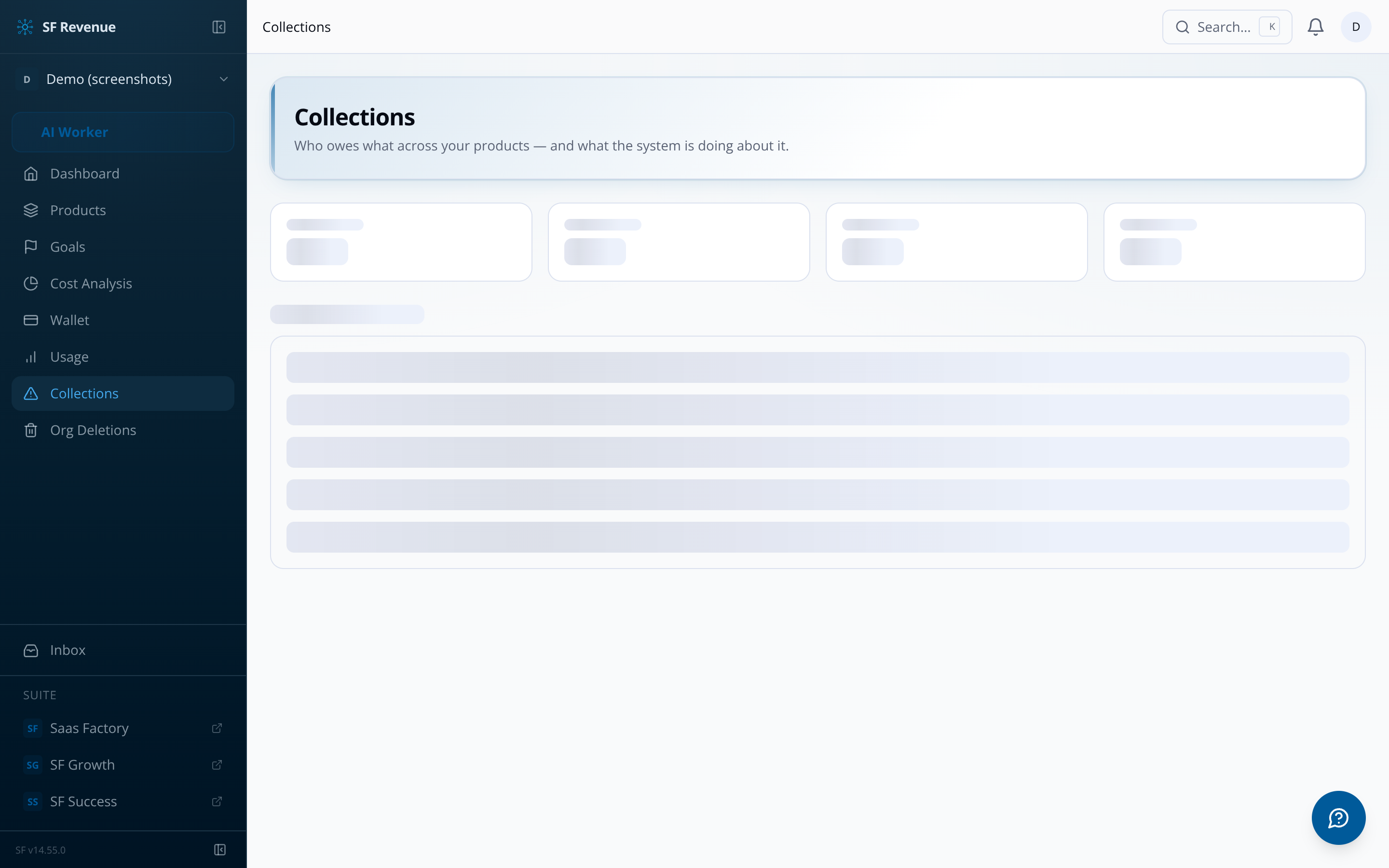
Collect what you're owed — automatically.
The collections cockpit tracks every overdue invoice through its full chasing lifecycle. Churn-risk signals and reconciliation alerts sit in the same view — so you act on the customers worth saving before the ladder reaches suspension.
Per-invoice chasing history alongside the invoice itself
Reconciliation alerts when usage is metered but under-billed
Win-back campaigns for recently churned customers
[ INTELLIGENCE / AI LAYER ]
The AI handles the billing setup. You approve it.
Pricing strategy, churn detection, and upsell identification run in the background. Every approval step today is transitional scaffolding — as agent confidence is proven, the AI takes the loop entirely.
Revenue strategy suggestions
Weekly AI-generated pricing and monetization recommendations, queued for your review — not fired without approval.
Churn risk scoring
Daily scoring across your customer base, with confidence levels that improve as won/declined signals accumulate over time.
Upsell detection
Fast-growing customers flagged automatically. Confidence scores that reflect this product's own realized conversion rate, not a generic guess.
[ COST ANALYSIS / BUDGET ]
Know your margins before the invoice arrives.
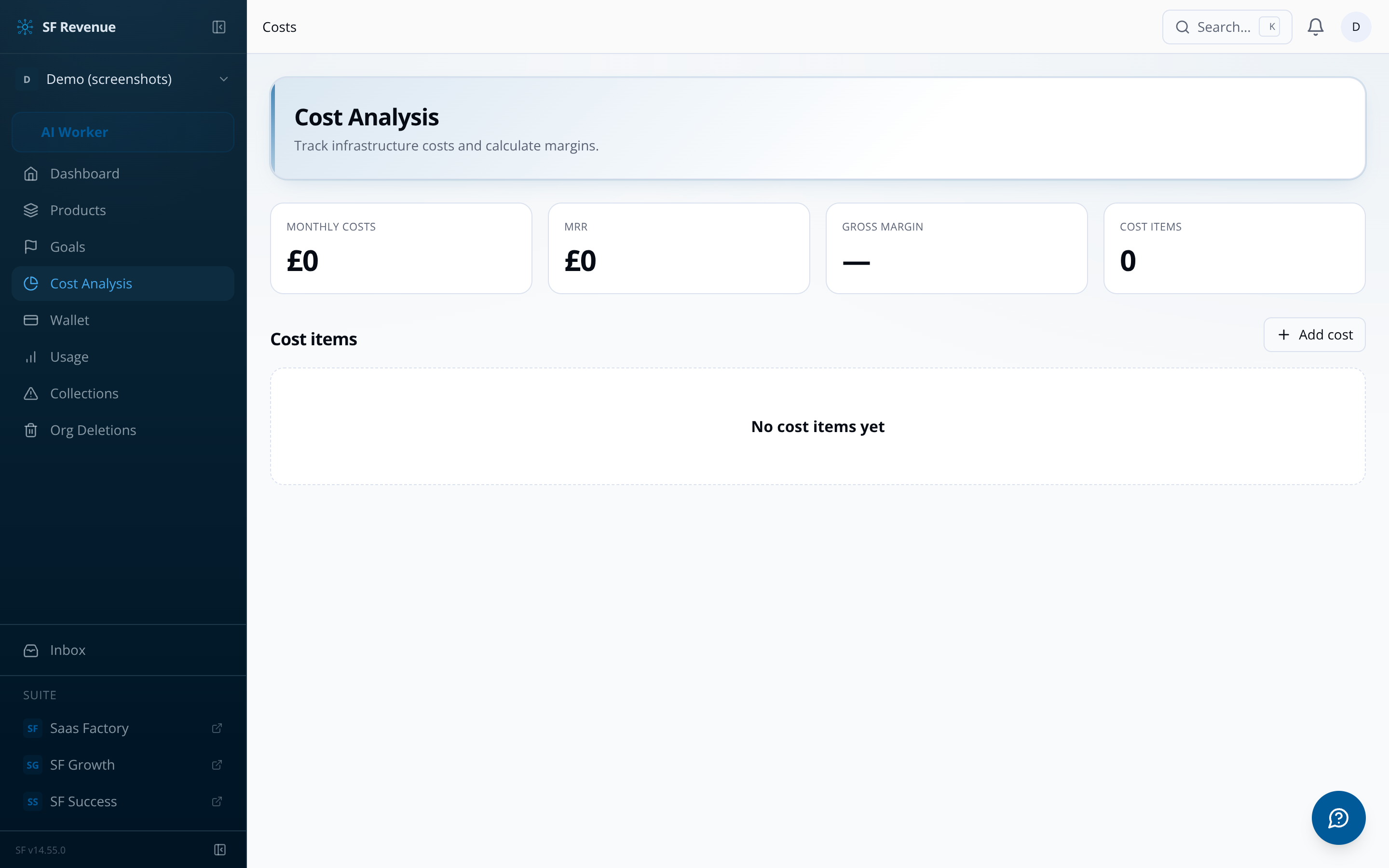
Log recurring and one-off costs against each product. Revenue goals with progress tracking sit alongside cost breakdowns so you can see contribution margin — not just gross revenue — at a glance.
Recurring and one-off cost items per product
Revenue goals with deadline tracking
Monthly budget cap with spend forecasting
Per-product budget pages with ownership isolation
[ ACTIVITY / AUDIT TRAIL ]
Every money-moving action, on record.
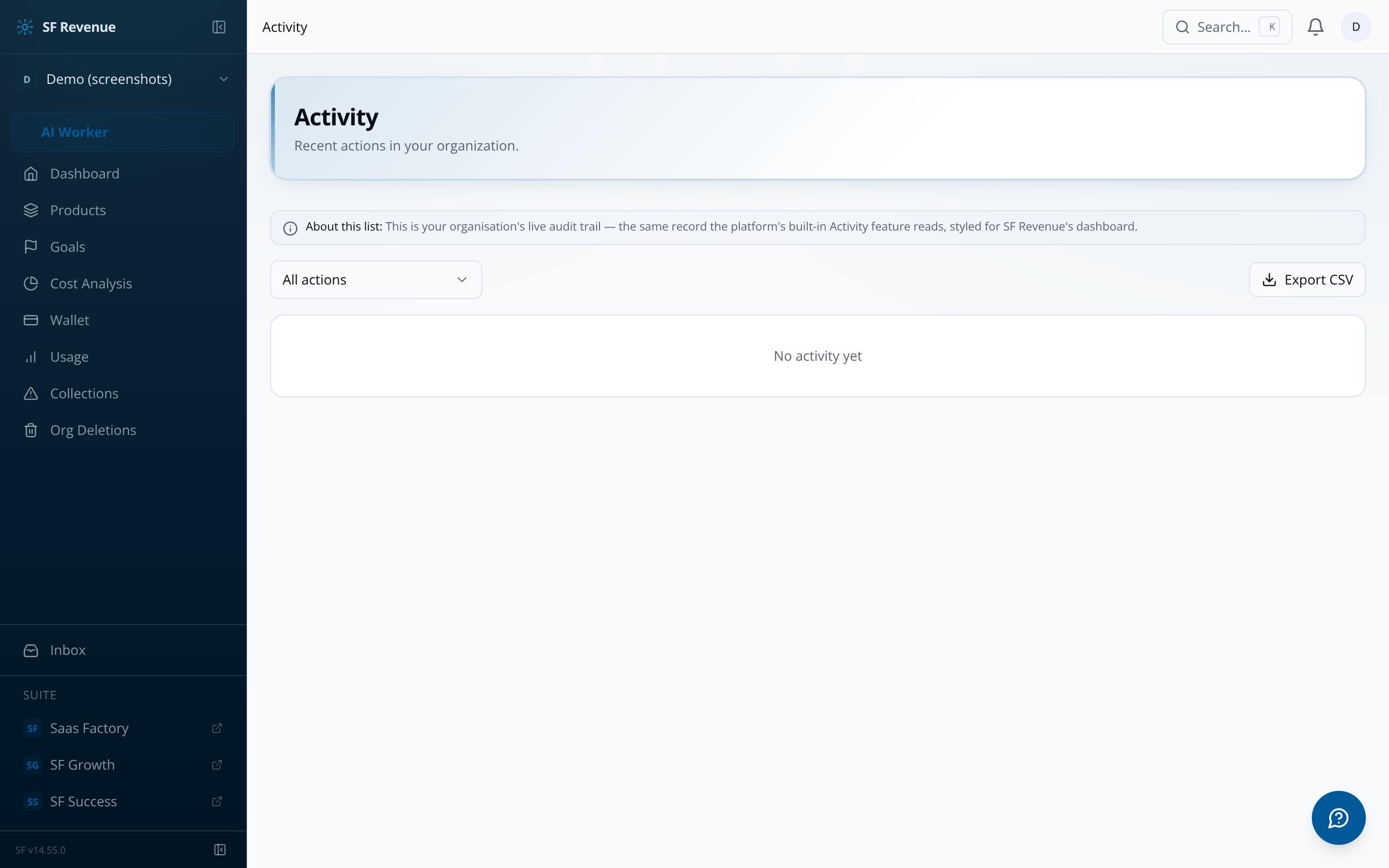
Who issued the invoice. Who requested the payout. Who changed the pricing plan. The activity log gives you a filterable, searchable audit trail for every financial state change in the system.
Financial audit trailInvoices, credits, payouts, and pricing changes — all logged with who acted and when.
Filterable by action typeSearch by team member, action category, or date range — no more digging through raw logs.
Subscription lifecycle eventsSign-up, upgrade, cancellation, and reactivation — traced for every customer across every product.
Reconciliation alertsDetected shortfalls surface here before they turn into a billing dispute.
[ FREQUENTLY ASKED ]
Questions about the billing engine.
SF Revenue is a billing and revenue operations engine for SaaS product builders. It handles subscription plan management, invoice generation, customer collections, churn scoring, wallet management with automated top-up, payout execution, dunning (the automated reminder-to-suspension ladder for late payers), and revenue analytics including MRR, ARR, and cohort retention. The product is designed so a founder without a finance or technical background can configure pricing plans, track what customers owe, and get paid — without building any of that infrastructure themselves.
The product includes AI-assisted revenue strategy suggestions: it analyses your product's billing data and surfaces pricing, monetisation, and upsell recommendations for you to review and act on. It also runs automated churn scoring — identifying which customers are at risk and flagging upsell opportunities. Humans remain in the decision seat: you approve or reject suggestions, and your team acts on flagged customers. The AI accelerates the analysis; it does not replace the person running the business. One known gap worth being upfront about: the plan-creation form is currently a manual process — AI-prepared plan suggestions are on the roadmap but not yet live in that specific flow.
SF Revenue uses Stripe Connect with SaaS Factory's platform account rather than a direct connection to your own Stripe account. This means your customers' payments, collections, and balances are tracked through the platform, and you withdraw your funds from your SF Revenue wallet. The reason for this structure — rather than letting you connect your own Stripe account directly — is that it allows the platform to handle reconciliation, dunning, and payout logic centrally on your behalf. Your wallet supports automated top-up (auto-recharge when the balance drops below a threshold you set) and manual withdrawals.
You can configure flat subscription plans and metered (usage-based) pricing add-ons — for example, charging a base monthly fee plus a per-unit rate for API calls, storage, or any usage category your product tracks. Annual billing is supported at the backend level. Per-seat pricing (charging by number of active team members) is not currently available as a built-in pricing dimension. The pricing plan editor lives inside your product's billing cockpit, and plans can be archived when retired.
Yes. SF Revenue runs an automated dunning sequence: reminder email, warning email, final warning, suspension, and eventual cancellation — each triggered on a schedule after an invoice goes overdue. The Collections dashboard shows you the full dunning queue, active payment-chasing actions, and reconciliation alerts for any billing shortfalls the daily sweep detects. At-risk customers are also scored for churn risk independently, so you can see which accounts need attention before they reach the dunning ladder. Reactivating a customer after they pay currently requires a manual step rather than happening automatically.
SF Revenue has compliance infrastructure in active development. A weekly data-retention purge runs to honour documented GDPR retention windows. Audit logging covers the majority of money-moving actions. The platform uses organisation-scoped data isolation and Stripe for payment processing. That said, a serious buyer should know that several compliance items are still being hardened: a cookie-consent banner is not yet live (despite being referenced in the privacy policy), some audit-log coverage gaps remain on subscription lifecycle events, and a Content Security Policy header was temporarily removed during a past incident and is being restored. We recommend requesting a full compliance status briefing before committing if you have specific SOC 2 or ISO 27001 audit requirements.